

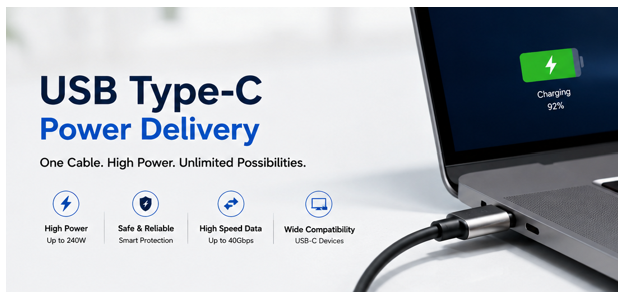
What Is USB Type-C Power Delivery?
USB Type-C Power Delivery (USB PD) is a fast-charging and power negotiation standard developed by the USB Implementers Forum (USB-IF). Unlike traditional USB interfaces that provide a fixed amount of power, USB PD enables devices to intelligently negotiate voltage and current levels, allowing significantly higher power delivery while maintaining safety and efficiency.
As modern electronics continue to demand more power, USB Type-C Power Delivery has become the industry standard for charging and powering smartphones, tablets, laptops, industrial equipment, medical devices, and automotive electronics.
Today, USB PD 3.1 supports up to 240W of power, making USB Type-C one of the most versatile connectivity standards available.
Why USB Power Delivery Matters
Traditional USB interfaces were originally designed for data transfer rather than high-power applications.
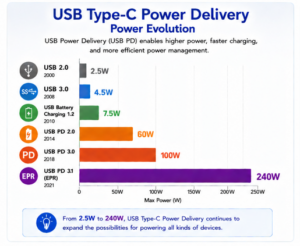
With the increasing adoption of USB Type-C, manufacturers can use a single connector for both high-speed data transmission and high-power charging, simplifying product design and improving user convenience.
Understanding USB Power Delivery Power Levels
USB PD allows devices to negotiate different voltage and current profiles based on their requirements.
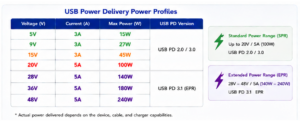
This flexibility allows USB Type-C connectors to support a wide range of applications, from charging mobile phones to powering high-performance laptops and industrial equipment.
How USB Type-C Power Delivery Works
One of the key advantages of USB PD is its intelligent power negotiation mechanism.
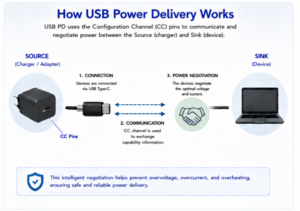
Before power is delivered, the Source device (such as a charger or power adapter) and the Sink device (such as a laptop or tablet) communicate through the Configuration Channel (CC) pins inside the USB Type-C connector.
The devices exchange information including:
- Supported voltage levels
- Current capabilities
- Maximum power requirements
- Power delivery profiles
Once both devices agree on a suitable power profile, power transmission begins.
This negotiation process helps prevent overvoltage, overheating, and excessive current flow, ensuring safe and efficient operation.
Connector Requirements for USB Power Delivery Applications
As power levels increase, connector quality becomes increasingly important.
Current Carrying Capacity
High-power USB PD applications require connectors capable of handling elevated current levels with minimal resistance.
Key considerations include:
- Low contact resistance
- Optimized terminal design
- Stable electrical performance
- High-quality contact materials
Poor connector design can lead to excessive heat generation and reduced system reliability.
Plating and Contact Reliability
Contact plating plays a critical role in maintaining long-term performance.
Proper plating helps:
- Reduce contact resistance
- Improve conductivity
- Enhance durability
- Prevent oxidation and corrosion
For applications involving frequent mating cycles, high-quality plating is particularly important.
Thermal Performance
As USB PD moves toward 100W, 140W, and even 240W power levels, thermal management becomes a major design consideration.
Engineers should evaluate:
- Temperature rise during operation
- Connector material selection
- Ventilation and cooling conditions
- Long-term reliability under continuous load
Durability
USB Type-C connectors are designed for repeated insertion and removal.
Typical requirements include:
- More than 10,000 mating cycles
- Stable mechanical retention
- Consistent electrical performance over time
For industrial and medical applications, durability often becomes a key selection factor.
Common Applications of USB Type-C Power Delivery
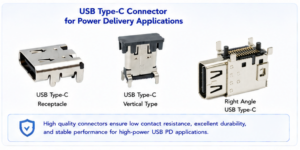
Consumer Electronics
USB PD is widely used in:
- Smartphones
- Tablets
- Laptops
- Gaming devices
- Portable accessories
Industrial Equipment
Industrial systems increasingly adopt USB Type-C for both power and communication.
Examples include:
- Industrial PCs
- Embedded systems
- Human-machine interfaces (HMIs)
- Portable test instruments
Medical Devices
Portable medical equipment benefits from standardized power delivery and compact connector designs.
Applications include:
- Patient monitoring devices
- Portable diagnostic systems
- Medical tablets and terminals
Automotive Electronics
USB Type-C Power Delivery is becoming increasingly common in modern vehicles.
Applications include:
- In-vehicle charging systems
- Infotainment systems
- Rear-seat entertainment systems
- Connected vehicle electronics
How to Select the Right USB Type-C Connector
Choosing the appropriate USB Type-C connector requires careful evaluation of application requirements.
Consider the following factors:
Power Requirements
Determine the maximum power level required:
- Standard charging
- Fast charging
- 100W USB PD
- 240W USB PD 3.1
Mounting Style
Select the appropriate connector configuration:
- Receptacle
- Plug
- Mid-mount
- Top-mount
- Vertical
- Right-angle
Environmental Conditions
Consider:
- Operating temperature
- Humidity exposure
- Vibration
- Dust protection requirements
Durability Requirements
Evaluate expected insertion cycles and mechanical stress throughout the product lifecycle.
Conclusion
USB Type-C Power Delivery has transformed USB from a simple data interface into a universal high-power connectivity solution. With support for up to 240W, USB PD enables a single connector to deliver power, data, and convenience across a wide range of applications.
For engineers and product designers, selecting the right USB Type-C connector is critical to ensuring reliable power delivery, thermal performance, durability, and long-term product success.
As USB Type-C adoption continues to expand across consumer, industrial, medical, and automotive markets, connector quality and design considerations will play an increasingly important role in achieving optimal system performance.
Frequently Asked Questions (FAQ)
What is USB Type-C Power Delivery?
USB Type-C Power Delivery (USB PD) is a charging and power negotiation standard that enables devices to safely deliver higher levels of power through a USB Type-C connector. The latest USB PD 3.1 specification supports up to 240W of power.
How does USB Power Delivery work?
USB Power Delivery uses the Configuration Channel (CC) pins within a USB Type-C connector to allow devices to communicate and negotiate voltage and current requirements before power is delivered.
What is the difference between USB Type-C and USB Power Delivery?
USB Type-C refers to the physical connector interface, while USB Power Delivery (USB PD) is the protocol that manages power transmission. A USB Type-C connector does not automatically support USB PD unless the device and circuitry are designed for it.
How much power can USB Type-C deliver?
Standard USB Type-C can provide up to 15W (5V/3A). With USB Power Delivery, power levels can reach 100W, while USB PD 3.1 Extended Power Range (EPR) supports up to 240W.
Can all USB Type-C connectors support 240W charging?
No. To support 240W charging, the connector, cable assembly, and device design must comply with USB PD 3.1 EPR specifications and be capable of handling higher voltage and current requirements.
Why is connector quality important for USB Power Delivery applications?
High-power USB PD applications require connectors with low contact resistance, reliable plating, strong mechanical durability, and good thermal performance to ensure safe and stable operation.
How do I choose the right USB Type-C connector for my application?
Key considerations include power requirements, mounting style, durability, environmental conditions, shielding requirements, and compliance with relevant USB standards.
Are USB Type-C connectors suitable for industrial and medical applications?
Yes. USB Type-C connectors are increasingly used in industrial automation, embedded systems, portable medical devices, and automotive electronics due to their compact design, high power capability, and versatility.
About Walta Electronic
Walta Electronic specializes in high-quality connectivity solutions, providing a full range of DisplayPort, HDMI, USB, and Type-C connectors, along with corresponding cables and customized wire harness solutions. With precision manufacturing and advanced R&D expertise, we deliver high-performance, reliable connectivity products for applications across consumer electronics, industrial equipment, medical technology, and automotive electronics.
Our mission is to enhance connectivity solutions, ensuring superior compatibility and long-term competitiveness for our customers.
什麼是 USB Type-C Power Delivery?
USB Type-C Power Delivery(簡稱 USB PD)是一項由 USB Implementers Forum(USB-IF)制定的快速充電與電力協商標準。與傳統 USB 介面只能提供固定功率不同,USB PD 可讓設備之間智慧協商電壓與電流需求,在兼顧安全性與效率的前提下提供更高功率的供電能力。
隨著電子產品對供電需求持續提升,USB Type-C Power Delivery 已逐漸成為智慧型手機、平板電腦、筆記型電腦、工業設備、醫療儀器及車載電子系統的主流供電標準。
目前 USB PD 3.1 最高可支援 240W 功率輸出,使 USB Type-C 成為目前最具彈性的連接介面之一。
為什麼 USB Power Delivery 如此重要?
傳統 USB 介面最初設計目的是資料傳輸,而非高功率供電。
隨著 USB Type-C 的普及,產品開發者可透過單一連接埠同時實現高速資料傳輸與高功率供電,不僅簡化產品設計,也提升使用者體驗。
USB Power Delivery 功率等級解析
USB PD 可根據設備需求協商不同的電壓與電流組合。
這種彈性讓 USB Type-C 能夠應用於從手機充電到高效能筆電、工業設備等各種產品。
USB Type-C Power Delivery 如何運作?
USB PD 最重要的特點之一,就是其智慧電力協商機制。
在供電開始之前,供電端(Source)與受電端(Sink)會透過 USB Type-C Connector 中的 CC(Configuration Channel)腳位進行通訊。
雙方會交換以下資訊:
- 支援的電壓範圍
- 可提供或需求的電流大小
- 最大功率需求
- 支援的 Power Delivery Profile
當雙方達成一致後,系統才會開始供電。
這種機制能有效避免:
- 過電壓(Over Voltage)
- 過電流(Over Current)
- 過熱(Overheating)
- 設備損壞
確保供電安全與系統穩定性。
USB Power Delivery 對連接器的要求
隨著供電功率持續提升,連接器品質的重要性也越來越高。
電流承載能力(Current Carrying Capacity)
高功率 USB PD 應用需要連接器具備優異的導電能力。
設計重點包括:
- 低接觸電阻
- 最佳化端子結構
- 穩定的電氣性能
- 高品質導電材料
若接觸電阻過高,容易導致溫升增加,進而影響產品可靠度。
電鍍品質與接觸可靠性
端子電鍍直接影響連接器的長期表現。
適當的電鍍設計可帶來:
- 更低接觸電阻
- 更佳導電性
- 更長使用壽命
- 抗氧化與抗腐蝕能力
對於需要頻繁插拔的設備而言,高品質電鍍尤其重要。
散熱與溫升管理
當 USB PD 功率提升至 100W、140W 甚至 240W 時,散熱設計成為不可忽視的重要因素。
工程師需評估:
- 長時間運作下的溫升表現
- 連接器材料選擇
- 產品散熱條件
- 長期負載下的可靠性
良好的熱管理設計有助於確保系統穩定運行。
耐插拔壽命
USB Type-C 標準要求連接器具備優異的機械壽命。
常見要求包括:
- 超過 10,000 次插拔循環
- 穩定的保持力
- 長期穩定的電氣性能
在工業設備與醫療設備應用中,耐久性更是重要的選型條件之一。
USB Type-C Power Delivery 的常見應用
消費性電子產品
- 智慧型手機
- 平板電腦
- 筆記型電腦
- 遊戲設備
- 可攜式周邊裝置
工業設備
越來越多工業系統開始採用 USB Type-C 作為供電與通訊介面。
例如:
- Industrial PC(IPC)
- Embedded Systems
- HMI 人機介面
- 可攜式測試設備
Medical
USB PD 的高效率供電與標準化設計非常適合醫療設備應用。
包括:
- 病患監測設備
- 可攜式診斷設備
- 醫療平板與終端設備
車載電子系統
現代汽車正大量導入 USB Type-C Power Delivery。
應用範圍包括:
- 車內充電系統
- 車載娛樂系統
- 後座娛樂設備
- 智慧聯網車輛設備
如何選擇適合的 USB Type-C Connector?
在選擇 USB Type-C 連接器時,應考量以下因素:
功率需求
首先確認產品需要支援的供電能力:
- 標準充電
- 快速充電
- 100W USB PD
- 240W USB PD 3.1
安裝方式
依產品設計需求選擇:
- Receptacle
- Plug
- Mid-Mount
- Top-Mount
- Vertical Type
- Right Angle Type
使用環境
需評估:
- 工作溫度
- 濕度環境
- 振動條件
- 防塵與防護需求
使用壽命
根據產品預期使用年限與插拔頻率,選擇符合需求的連接器規格。
結論
USB Type-C Power Delivery 已經從單純的充電技術發展成為現代電子設備的重要供電標準。從 15W 到 240W,USB PD 不僅提供更高的供電能力,也讓單一連接器能同時承擔電力與資料傳輸功能。
對產品開發工程師而言,選擇適合的 USB Type-C Connector 不只是滿足功率需求,更直接影響產品的可靠性、散熱表現與長期使用壽命。
隨著 USB Type-C 持續擴展至消費電子、工業設備、醫療科技及車載電子領域,高品質連接器將成為確保系統穩定運作的重要關鍵。
常見問題(FAQ)
USB Type-C Power Delivery(USB PD)是什麼?
USB Type-C Power Delivery(USB PD)是一種電力傳輸與充電協議,可透過 USB Type-C 連接器提供比傳統 USB 更高的供電能力。最新的 USB PD 3.1 規範最高可支援 240W 功率輸出,廣泛應用於筆記型電腦、工業設備及各類電子產品。
USB Power Delivery 是如何運作的?
USB Power Delivery 透過 USB Type-C Connector 中的 CC(Configuration Channel)腳位進行通訊,讓供電端與受電端在供電前先協商適合的電壓與電流規格,確保供電效率與使用安全。
USB Type-C 與 USB Power Delivery 有什麼差別?
USB Type-C 是連接器的外觀與介面規格,而 USB Power Delivery(USB PD)則是電力傳輸協議。
換句話說:
- USB Type-C = 連接器
- USB PD = 充電協議
並非所有 USB Type-C 連接器都支援 USB Power Delivery,仍需依產品設計與系統規格而定。
USB Type-C 最大可以提供多少功率?
標準 USB Type-C 可提供最高 15W(5V / 3A)的供電能力。
若支援 USB Power Delivery:
- USB PD 3.0:最高可達 100W
- USB PD 3.1 EPR:最高可達 240W
因此 USB Type-C 已能滿足從手機到高效能筆記型電腦等多種設備的供電需求。
所有 USB Type-C Connector 都支援 240W 充電嗎?
不一定。
若要支援 240W 充電,連接器、線材及設備都必須符合 USB PD 3.1 Extended Power Range(EPR)規範,並具備承受高電壓與高電流的設計能力。
因此在選擇 USB Type-C Connector 時,應確認其是否符合實際功率需求。
為什麼連接器品質對 USB Power Delivery 很重要?
高功率 USB PD 應用會產生較高的電流與熱量,因此連接器必須具備:
- 低接觸電阻
- 穩定的端子結構
- 優異的電鍍品質
- 良好的散熱性能
- 長期可靠性
品質不佳的連接器可能導致發熱、供電不穩定,甚至影響產品壽命。
如何選擇適合的 USB Type-C Connector?
選型時建議評估以下因素:
- 所需功率等級(15W、60W、100W 或 240W)
- 安裝方式(SMT、DIP、Vertical、Right Angle 等)
- 使用環境
- 插拔次數要求
- 遮蔽與 EMI 需求
- 是否符合 USB PD 規範
選擇符合應用需求的連接器,有助於提升產品穩定性與可靠性。
USB Type-C Connector 是否適用於工業與醫療設備?
是的。
由於 USB Type-C 具備高功率供電、高速資料傳輸及體積小巧等優勢,已廣泛應用於:
- Industrial PC(IPC)
- Embedded Systems
- HMI 人機介面
- 可攜式醫療設備
- 診斷儀器
- 車載電子系統
因此越來越多工業與醫療產品開始採用 USB Type-C 作為標準介面。
關於 Walta Electronic
Walta Electronic 專注於高品質連接解決方案,提供完整的 DisplayPort、HDMI、USB、Type-C 連接器,以及相關線材與客製化線束組裝服務。憑藉精密製造能力與豐富研發經驗,我們為消費電子、工業設備、醫療科技及車載電子等領域提供高可靠性的連接產品,協助客戶打造更穩定、更具競爭力的產品設計。